Research artefact
MindfulBeat - Semi-Automatic Heart Rate Monitor
A Wear OS smartwatch application exploring how in-the-moment prompts and personal notes can help people reflect on heart-rate data.
Project overview
Most smartwatch heart-rate tracking happens automatically, often leaving people with graphs but little context about what was happening when their heart rate changed. I designed and built a semi-automatic heart-rate monitor that invites people to add that context themselves.
When the watch detects a high heart rate, it sends an alert and asks the wearer to record an activity or emotion. They can then explore their heart rate over the day alongside those personal notes, connecting sensor data with the events and feelings around it.
Application screens
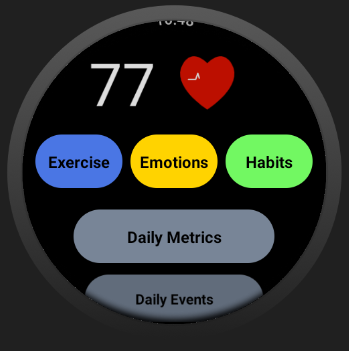
Main screen
The home screen provides quick access to heart-rate features and personal event logging.
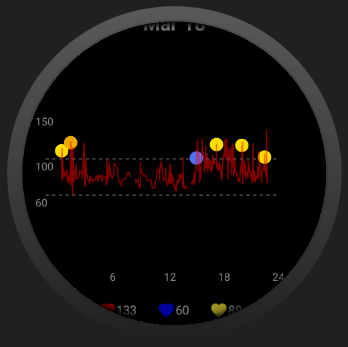
Daily metrics
A timeline plots heart rate through the day and marks moments connected to recorded events.
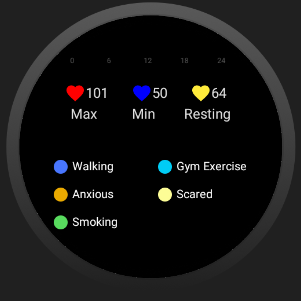
Heart-rate and event summary
Daily metrics bring heart-rate values together with recorded activities and emotions.
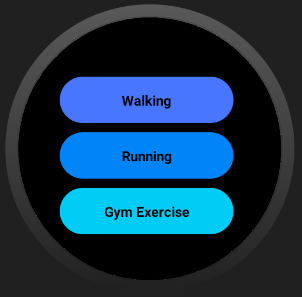
Activity annotations
Wearers can quickly choose an activity to add context to a heart-rate event.
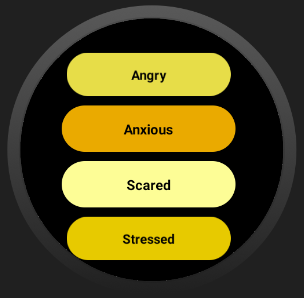
Emotion annotations
Wearers can add emotional context to a heart-rate event using quick choices on the watch.
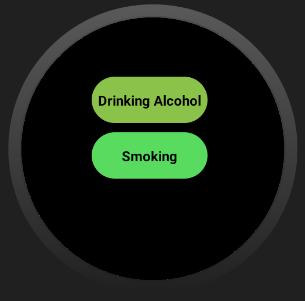
Habit annotations
The event logging flow also lets wearers record relevant habits.
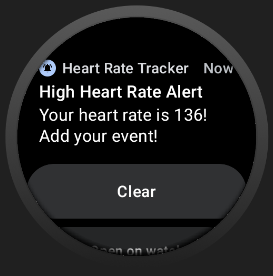
High heart-rate notification
An alert prompts the wearer to notice an elevated reading and record what they were doing.
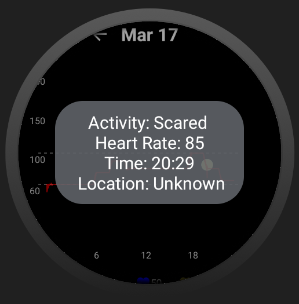
Event details
A selected event displays its recorded activity, heart rate, time and location alongside the daily graph.
Study and findings
I evaluated the prototype in everyday settings with nine participants. They used the smartwatch for seven days and then took part in semi-structured interviews. I analysed the interviews using an inductive, grounded-theory approach.
-
In-the-moment health reflection
Prompts helped participants pause and consider the context in which a heart-rate change happened.
-
Narrative health visualisation
Pairing personal notes with sensor readings offered a more contextual account than either data type alone.
-
Multidimensional health engagement
Notifications, personal input and graphs served different purposes and complemented one another.
Technology
-
Kotlin and Android Studio
The smartwatch application was developed in Kotlin using Android Studio.
-
Wear OS and Jetpack Compose
Jetpack Compose was used to build the interface for the small smartwatch display.
-
On-device data
Heart-rate readings and event records were stored locally on the watch.